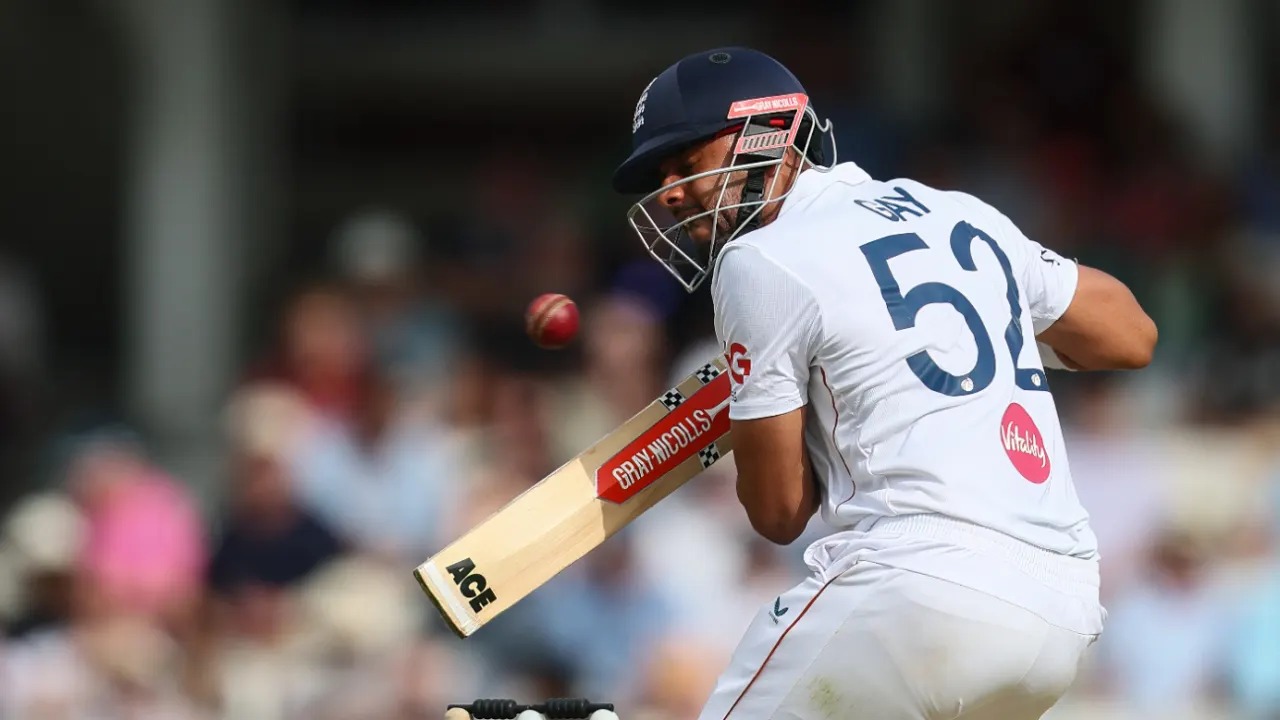
The Oval — On a warm second afternoon at The Oval, the line between a hard-fought Test match and a sudden batting collapse came down to a faint sound, two insistent fielders, and a reluctant captain. New Zealand found themselves needing a spark. England’s Emilio Gay was batting with a steely determination, having just ground out a resilient, 112-ball half-century. To celebrate the milestone, Gay rolled his wrists over a short ball from Kiwi quick Will O'Rourke, pulling him confidently to the boundary for four. It felt like England was settling in for the long haul. Two balls later, everything changed. O'Rourke hit the deck hard, sending down a sharp, back-of-a-length delivery that forced Gay to flinch, his top hand ripping off the bat handle in self-defense. On the pitch, the reaction suggested a near-miss. O'Rourke muttered a few words of frustration but didn't appeal. Wicketkeeper Tom Blundell and Daryl Mitchell at first slip threw their heads back in shared anguish over what looked like a standard play-and-miss. Stand-in captain Tom Latham, stationed at second slip, looked entirely unmoved. He was ready to walk back to his mark and let the game flow on. But the outer ring of the slip cordon had other ideas. Henry Nicholls, watching intently from third slip, and Devon Conway, hovering in the gully, immediately sparked to life. They hadn't just watched the ball; they had heard something. As the DRS timer ticked down, the duo converged on a hesitant Latham, pleading their case with absolute certainty. They insisted a distinct noise had echoed from the blade. Coaxed into a review he clearly felt sheepish about taking, Latham raised his arm to signal the third umpire. What followed was pure theater. As the television replays rolled, the New Zealand team watched the big screen. The ball passed the glove, then the bat. When the UltraEdge technology kicked in, it didn't just show a faint murmur—it spiked violently, confirming a healthy outside edge. Gay was out. "Dev [Conway] was probably the biggest advocate for it," Glenn Phillips said from backward point after the day's play. "I think it potentially snuck his grille. Just with obviously how quick everything happens, you never quite know from the sidelines, but there was definitely quite a big noise from where we heard it. The lads that were a bit more in-line saw that it was close to his batting gloves. It was worth the option and the risk to take that review. It paid off very nicely." The breakthrough acted as a total adrenaline shot for the Black Caps. With Gay broke the stubborn opening dam, the Kiwis poured through. The prized wickets of Joe Root and Harry Brook fell in rapid succession, completely shifting the gravity of the second Test into New Zealand's hands. For Gay, the walk back to the pavilion was filled with the bitter taste of missed opportunity. Having scored a stabilizing fifty at Lord's the week prior, the Durham batsman knew he had let a massive century slip through his fingers. "The dismissal I was disappointed with, especially getting a nice pull shot off him two balls before," Gay admitted frankly after stumps. "Change of angle, and I just didn't pick it up as well as I would have liked. To go out there today and feel fairly good, but get a fifty and not convert it, I was disappointed with that. All I can do is look forward to the second innings." In Test cricket, matches are won in the microscopic gaps between the bat and the ball. Thanks to the sharp ears of Conway and Nicholls, New Zealand didn't just find the edge—they found a path to absolute control at The Oval.
The Sound of Success: How Conway and Nicholls Masterminded England’s Oval Collapse
The Oval — On a warm second afternoon at The Oval, the line between a hard-fought Test match and a sudden batting collapse came down to a faint sound, two insistent fielders, and a reluctant captain. New Zealand found t